Huawei Launches Innovative All-Optical Solutions for AI-Centric Networks
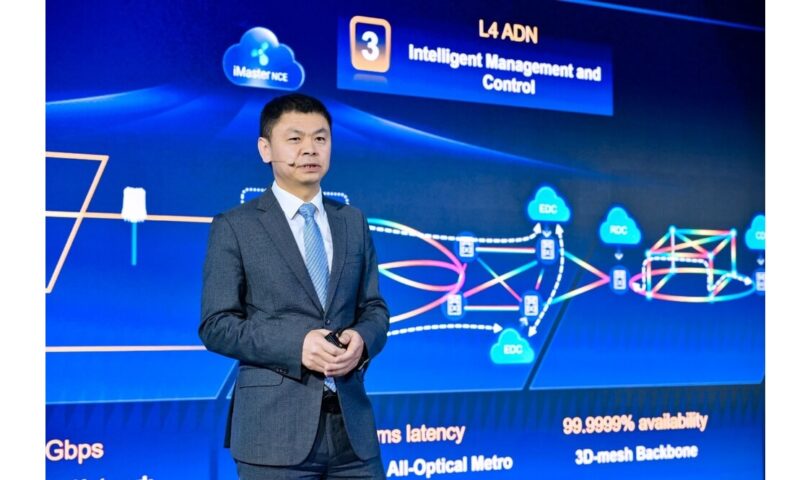
At the Green All-Optical Network Forum held during MWC 25 in Barcelona, Kim Jin, Vice President of Huawei Optical Product Line, introduced four groundbreaking all-optical solutions designed to assist global operators in constructing AI-centric F5.5G All-Optical networks. These solutions aim to facilitate a mutually beneficial outcome in the era of intelligence.
The global AI industry is experiencing rapid growth, which is accelerating the commercial utilization of 10 Gbit/s home broadband and 1 ms all-optical metro networks. Huawei’s cutting-edge solutions offer comprehensive network implementation tools for operators worldwide.
Optical Access Network: The demand for 10GE access is increasing with the rise of AI technology. Huawei has developed the industry’s first intelligent OLT solution, MA5800T X17, and has now introduced X15, X8, and X2 to cater to varying capacity requirements. These solutions boast the highest T-level forwarding capability in the industry and support high-density 50G PON, enabling operators to establish networks that can evolve over the next decade. The FAN Intelligent Engine architecture, in conjunction with NCE, supports application-level private line services, cross-user Wi-Fi optimization, and on-demand computing power scheduling, facilitating the realization of “Network as a Service.”
Metro Network: Huawei’s AI-oriented All-optical Metro Architecture, launched last year, was designed to achieve 1 millisecond latency for both DCA and DCI. The introduction of the industry’s highest-speed single-wavelength 2T board solution, coupled with the new TFLN modulator, has increased single-wavelength capacity from 1.6 Tbit/s to 2 Tbit/s, resulting in a 20% reduction in cost per bit. The ocean current power-saving algorithm automatically shuts down idle circuits based on real-time traffic, leading to a 50% reduction in power consumption. Additionally, the latency pre-detection and planning feature proactively detects fiber latency, supports latency map views, and provides AI services planning capabilities.
Backbone Network: Huawei’s OSN 9800 K series, the industry’s first DC-oriented OTN solution, was released last year. The introduction of K12, supporting more scenarios with a smaller shelf, offers enhanced performance and extended range for 800G through an enhanced FEC algorithm. This solution reduces optical rerouting time, optimizes costs, and ensures network availability at 99.9999%. The incorporation of hitless switching, dual-fed dual-receive, and fast deduplication algorithms enhances AI computing efficiency.
Intelligent Management and Control: Huawei iMaster NCE incorporates AI for intelligent management and control. The HBB Agent can proactively identify and rectify faults in all-optical access networks, reducing user complaints by 60%. The digital map feature proactively identifies network and service risks in all-optical transmission, swiftly resolving issues within 15 minutes.
In conclusion, Kim Jin emphasized the transformative power of AI in shaping the future of optical networks. Huawei’s continuous innovation aims to assist operators in building high-quality, efficient AI-centric F5.5G All-Optical Networks, enabling them to capitalize on new opportunities.
SOURCE: Huawei