CALGARY, AB, Dec. 17, 2025 /PRNewswire/ — In an Open Letter to the Office of the Superintendent for Financial Institutions (OSFI) of Dec. 05, 2025, Friends of Science Society challenged OSFI’s recent accolades for climate risk reports received from several major Canadian banks and insurance firms. A key criticism by Friends of Science Society relates to an economic study which had been retracted days earlier.
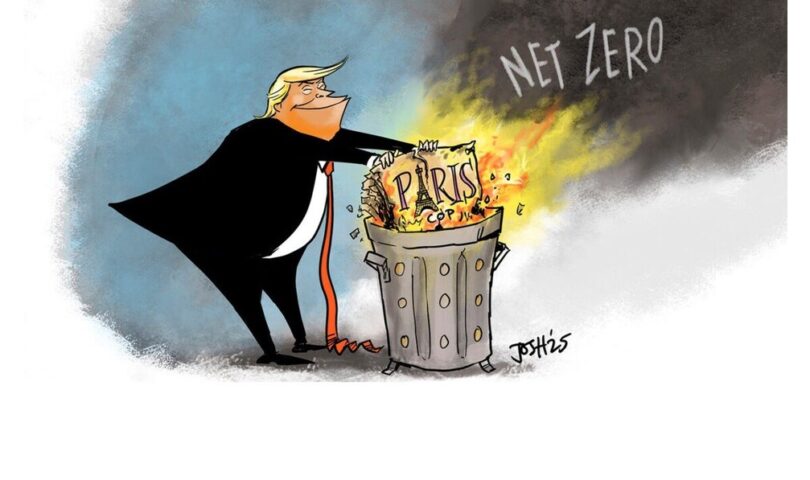
@Cartoonsbyjosh
Trump flaming Paris Agreement. Used with permission.
Cover of “He Shoots; Does He Score? The Canada-Alberta Memorandum Of Understanding” Cover image licensed from Adobe Stock by TanTin.
On Dec. 03, 2025, the science journal NATURE retracted Kotz et al (2024), “The economic commitment of climate change,” a highly publicized study. This study had been adopted by the central banks, which are party to the Network for Greening the Financial System (NGFS), as a basis for climate risk analysis.
Canada has committed to a stringent Net Zero 2050 emissions reduction target, says Friends of Science Society. They argue in the letter to OSFI that the Kotz et al study wildly exaggerates the economic damage to global GDP. A Wall Street Journal editorial of Dec. 09, 2025, reported that the Kotz et al study suggests that climate change could cause $31 trillion in damages by 2049. For context, in 2024, North America GDP was ~$31.4 trillion. If Canadian banks and insurers are using Kotz et al as a basis for climate risk analysis, Friends of Science Society argues that financial climate risk policies (which include lending and insurance) are also being skewed.
An earlier analysis by Friends of Science Society’s president, Ron Davison, P. Eng., titled, “Net Zero: Climate Policy is All Pain for Minimal Gain,” revealed the economic costs to Canada from climate change would be nominal; the economic damage from trying to reach Net Zero would be staggering.
One example noted in Friends of Science Society’s letter to OSFI is that a proposed bill known as the Climate Aligned Finance Act (CAFA, Bill S-238, also known as Enacting Climate Commitments Act), which intends to significantly restrict financing for energy-intensive industries would find credence from the banking sector, if reliant on Kotz et al. The Act references: “Whereas the Bank of Canada recognizes that climate change poses significant risks to the financial system and the economy, including physical risks that arise from more frequent and severe extreme weather events and risks that stem from the transition to a low-carbon, net-zero economy…”
Climate scientist Dr. Madhav Khandekar, former WMO regional expert, past IPCC expert reviewer and 40 year veteran research scientist of Environment Canada, discussed the problem of people conflating extreme weather events as if evidence of climate change in this Friends of Science presentation. Khandekar recommends that society should develop adaptations to climate change rather than trying to control the weather by restricting the use of fossil fuels.
Prime Minister Mark Carney has positioned Canada as a would-be energy superpower and recently signed a Memorandum of Understanding (MOU) with the province of Alberta. A key focus is on ultimately building a new pipeline to the West Coast to access world markets. Friends of Science Society argues in its letter to OSFI, that skewed climate risk analysis and climate targets, along with a bill like Enacting Climate Commitments Act, would deindustrialize Canada in a similar manner to Germany’s present state of industrial decline.
Friends of Science Society has issued a new report about the Canada-Alberta MOU, written by retired energy economist and former public servant and diplomat, Robert Lyman, titled “He Shoots; Does He Score?” The title reflects a nod to Prime Minister Carney’s election hockey metaphors.
The Trump administration has abandoned the Paris Agreement and Net Zero, moving rapidly to build out energy systems; thus, the climate policies in Canada are at odds with its largest trading partner. Under the Canada-Alberta MOU, Alberta is relieved of clean electricity grid regulations and will be advancing AI, however, as Lyman notes in his report, the likelihood of a pipeline is low and contested, as outlined in this Friends of Science Society video.
Friends of Science Society’s position is that the Canadian banking sector has adopted an unwarranted catastrophic view of climate change that is not supported by the broader scientific evidence. Over 2,000 scientists and scholars, including many Friends of Science Society members, have signed the CLINTEL World Climate Declaration that there is no climate emergency.
About
Friends of Science Society is an independent group of earth, atmospheric and solar scientists, engineers, and citizens that is celebrating its 23rd year of offering climate science insights. After a thorough review of a broad spectrum of literature on climate change, Friends of Science Society has concluded that the sun is the main driver of climate change, not carbon dioxide (CO2).
Friends of Science Society
PO Box 61172 RPO Kensington
Calgary AB T2N 4S6
Canada
Toll-free Telephone: 1-888-789-9597
Web: friendsofscience.org
E-mail: contact(at)friendsofscience(dot)org
Web: climatechange101.ca
SOURCE Friends of Science Society